Everyone tells you this city doesn't walk. For a long time I believed it, mostly because I was always in a car and always slightly late.
Then somebody took me up a set of concrete steps between two houses in the hills. I stood at the top completely out of breath, looked back down, and understood I had been wrong in a very specific way.
A city that used to walk
There are more than a hundred public stairways in Los Angeles. Most were built in the early 1900s, back when people lived on the hillsides and needed a way down to the streetcar lines. The streetcars are long gone. The stairs stayed, because nobody ever got around to taking them out, and now they sit there like the fossil of a version of this city that went everywhere on foot.
Silver Lake alone has fifty two of them. There is a guidebook with forty two walks in it. There are people who have done all forty two. There is a club in Santa Monica that meets on the Adelaide stairs at 6:15 in the morning, which is a sentence I have had to make my peace with.
They are genuinely public, and that part surprised me most. They run between people's houses, past kitchen windows and lemon trees and somebody's recycling, and you are allowed to be there. For the first minute it feels like you aren't. Then it stops feeling like that.

The famous ones, and the quiet ones
Search for hidden stairs in Los Angeles and you get the same handful of names, and they earned it.
The Music Box Steps in Silver Lake are the ones from the Laurel and Hardy short, the one where they try to get a piano up a staircase. It won an Oscar in 1932. People still stand at the bottom and laugh a little before they start climbing, which I think is the correct response.
The Mattachine Steps in Echo Park have a plaque for Harry Hay, who founded one of the country's first gay rights organizations on that hillside in 1950. A hundred and sixty one steps that end in somebody's cul de sac. Then you turn around and there is the reservoir.
Baxter Street is two hundred and thirty one steps up to Elysian Park and people run them on purpose, a fact I am reporting without further comment.
And there is the painted one, the bright staircase in Silver Lake covered in hearts. It is genuinely lovely and it is on everybody's grid, which means it is never empty. If you want a photo without four people waiting behind you, go somewhere else.
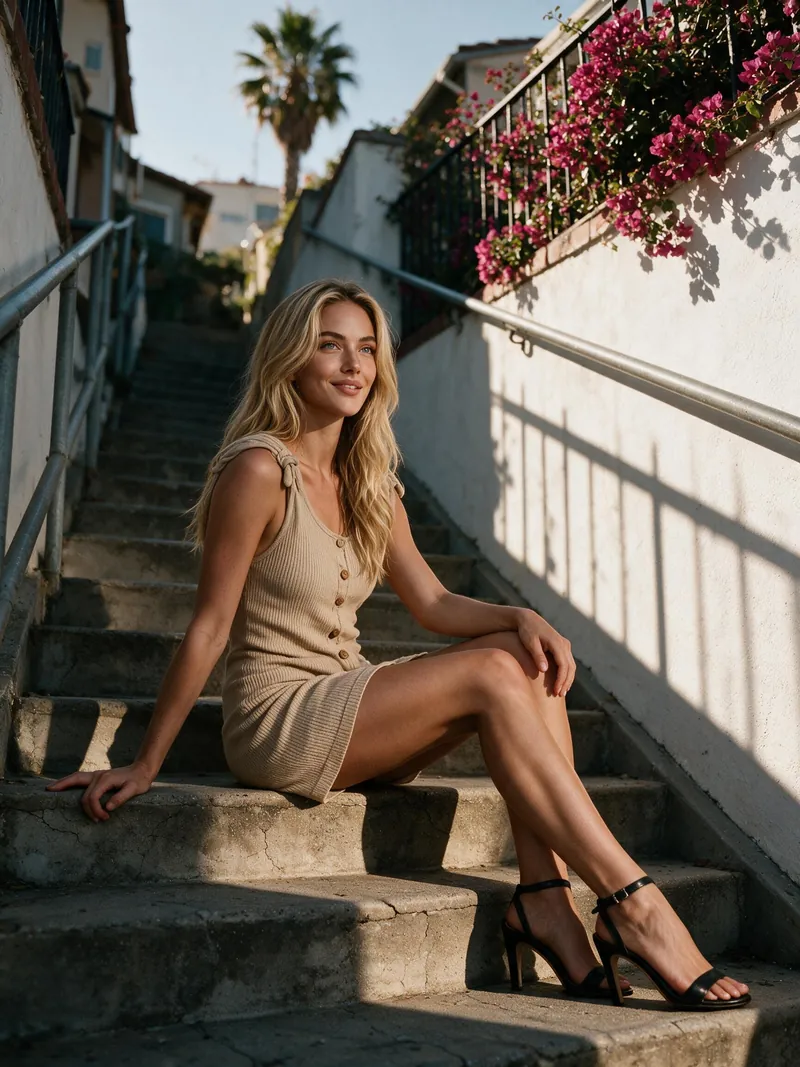
The ones I keep going back to don't have names I could give you. Narrow flights with a plain pipe handrail down one side, and bougainvillea coming over a white wall like it is trying to escape. Some are walk streets, whole little blocks with no road at all, just a path and front doors. I don't post those locations, and not because I am precious about it. People live there.
What to wear if you plan to actually climb
Here is the honest gap between what a photo looks like and what the morning looked like.
The heels in these pictures are real. They were also in my bag for most of the climb, next to the sneakers I wore up. Two hundred steps in a thin heel is not a look, it is an injury with a caption.
So: something you can move in. Something with a bit of weight to it, because the top of a staircase is always windier than the bottom and anything short and floaty will spend the entire climb doing things you did not ask it to do. Ribbed cotton, a heavier knit, a skirt that hangs instead of lifts. Steps are unforgiving to fabric that has opinions.
Shoes go in the bag. Water goes in the same bag. There is never a bathroom.
The light does most of the work
Two windows, and neither is the one you would guess.
Before eight, the marine layer is still lying over the city and everything is flat and soft and faintly blue. It is not dramatic light. It is kind light, and it makes the whole flight read as one quiet thing instead of a hundred hard edges. If you want to know what that hour is like somewhere with an actual view, I wrote about Runyon at six separately.
Late afternoon is the opposite, and it is my favorite. The sun comes in sideways, straight down the length of the stairs, and the handrail throws a shadow across every single step like a ladder lying on its side. That is the twenty minutes. Show up at the wrong hour and the same staircase is gray concrete in flat sun, and you will wonder what I was going on about.
House rules
They are public and they run straight through people's actual lives.
Keep your voice down before eight. Don't hold the flight for twenty minutes while you get the shot. Step aside for whoever is coming through with groceries, because for them this is not an activity, it is the stairs. Don't go through gates. Don't pull the flowers, they belong to somebody. Take your cup home with you.
That is the entire list, and it is not much to ask of something that costs nothing and has been standing there for a hundred years.
Where I would start
Pick a neighborhood on a hill and walk until you find one. Silver Lake, Echo Park, Highland Park, Beachwood, or the Palisades if you want an ocean waiting at the top. You will find one. That is sort of the point of a hundred staircases.
Bring water. Wear the sneakers. Put the other shoes in the bag.
And for the record, nobody agrees how many steps the painted one has. I have seen 177, 204, 205, and once, confidently, 78. I have climbed it and I still could not tell you. Somewhere in the neighborhood of a lot.
Mornings are public. Evenings are mine. The folder is one night in three chapters, and it lives here.